STILLWATER, Okla. (May 18, 2026) —
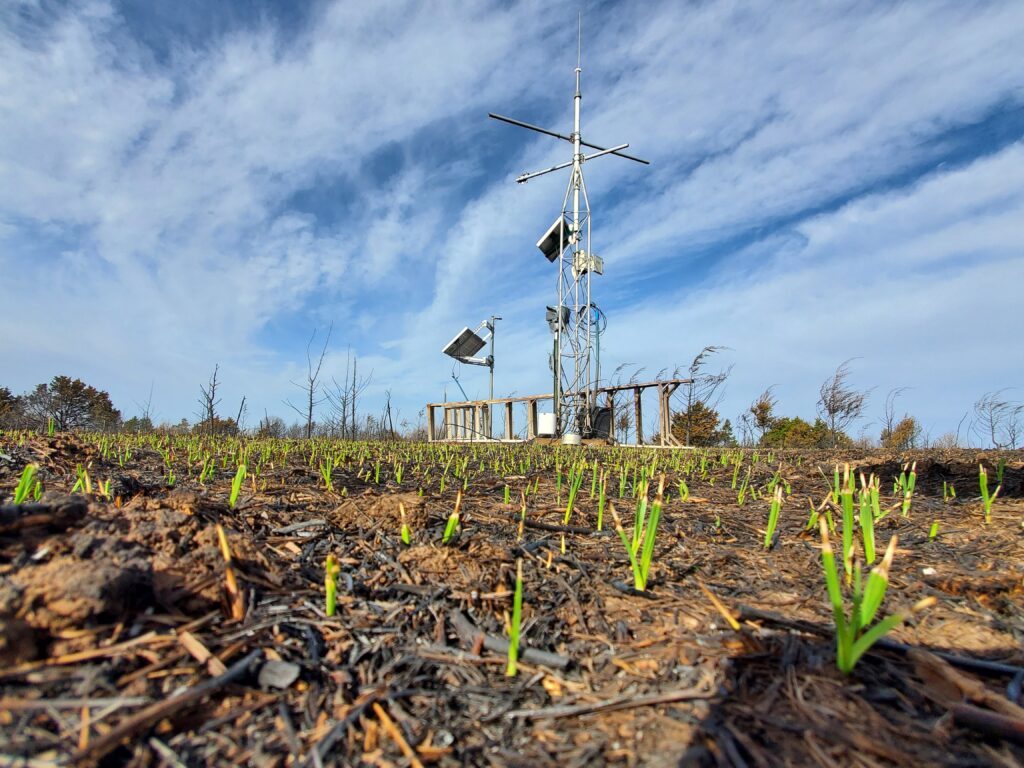
Ice storms, droughts, wildfires and other natural hazards put energy availability at risk for the more than 1.1 million customers of Oklahoma’s electric cooperatives. Scientists and industry leaders from across the state have studied how to make the power grid stronger in the face of these challenges, and they are making their results available to the public.
Researchers on the Socially Sustainable Solutions for Water, Carbon, and Infrastructure Resilience in Oklahoma (S³OK) project, worked closely with the Oklahoma Electric Cooperative and Oklahoma Association of Electric Cooperatives to find practical solutions to these problems. Their findings are described in a newly released publication titled “Socially Sustainable Solutions for Natural Hazards and Utility Resilience.”
“What sets this work apart is its grounding in real-world conditions,” said Maggie Leόn-Corwin, a research scientist on the S³OK project. “These insights are essential for building systems that serve communities.”
S³OK researchers worked directly with utility professionals, agencies and emergency management professionals to understand the practical side of power-grid management. The team also used surveys of more than 2,000 Oklahoma residents to understand how ordinary people respond to utility disruptions.
These collaborations “create a foundation for innovative strategies that meet the demands of a rapidly changing energy landscape,” says the publication.
This research provides crucial resources for utility planners to predict threats and manage resources, including:
— Improving prediction skill for “cold-air outbreaks” across the Central U.S.
— Predicting peak power demand using subseasonal circulation patterns
— Laying the groundwork for updated “hazard maps” for rural utility planning, integrating climate projections, wildfire risks and utility infrastructure vulnerabilities
— Creating detailed models to evaluate power distribution systems during ice storms, including factors such as falling limbs, ice accumulation and wind speed and direction
— Examining the reliability of electric distribution networks during “high-impact/low-probability events,” finding that traditional methods often fail to predict how the system will behave during extreme events
— Assessing performance of the power grid before, during and after storms, and comparing the effectiveness of grid management strategies
The S³OK project is a collaboration between researchers at the University of Oklahoma, Oklahoma State University, Langston University, Southwestern Oklahoma State University, the University of Tulsa, East Central University and the Noble Research Institute. Funding was provided by a $20 million grant from the National Science Foundation and generous $4 million support from the Oklahoma State Regents for Higher Education, administered through the Oklahoma Established Programs to Stimulate Competitive Research (OK EPSCoR).
###
The “Socially Sustainable Solutions for Natural Hazards and Utility Resilience” chapter is available at https://shareok.org//handle/11244/341835
This material is based on work supported by the U.S. National Science Foundation under Grant No. OIA-1946093. Any opinions, findings, and conclusions or recommendations expressed in this material are those of the author(s) and do not necessarily reflect the views of the U.S. National Science Foundation or Oklahoma State Regents for Higher Education.